Tasha Thompkins
Missing YouTasha Thompkins is Douglas Mastriani’s girlfriend and an education major whose commitment to an alternative high school makes her one of the clearest advocates for reimagining Pine Heights Elementary. She brings educational purpose and practical confidence to Douglas’s campaign, helps sustain his personal growth, and eventually invites Jessica Mastriani to imagine teaching music at the school they hope to create.
Identity and Relationships
Tasha is the daughter of the Thompkins family, who live across the street from the Mastrianis on Lumbley Lane. The families see one another often, including at dinners hosted by Jessica’s parents. Their continued closeness matters against the background of the Thompkins family’s painful connection to the neighborhood: although seeing Jessica could recall difficult memories, they remain nearby and become part of the Mastrianis’ regular family life. Tasha’s relationship with Douglas grows within that shared community rather than apart from it.
The relationship is presented as unusually steady by comparison with the romantic histories of Douglas’s siblings. Jessica regards it as the longest-lasting and probably emotionally healthiest relationship among the three Mastriani children so far. She likes Tasha both personally and because Tasha has followed her advice and not broken Douglas’s heart. Jessica’s joking promise to retaliate if Tasha hurt him makes her protectiveness plain, but the warmth of the family scenes also shows how fully Tasha has been welcomed. When Douglas greets Jessica with a shy kiss on the cheek, the small gesture marks a striking change from his difficulty touching another person three years earlier. Tasha is beside him in this more open phase of his life, though the narrative does not reduce that change to her influence alone.
The Pine Heights Campaign
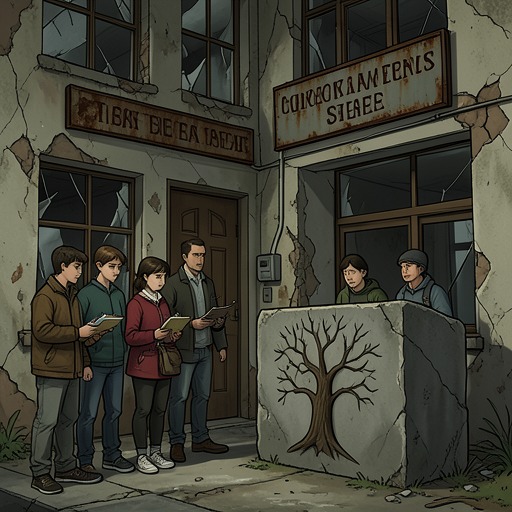
Tasha and Douglas oppose the closure of Pine Heights Elementary, the neighborhood school attended by the Mastriani children. The school board plans to shut it because too few children remain in the neighborhood, while the city’s proposed alternative is to convert the building into luxury condominiums. Douglas talks constantly about the school campaign, but Tasha gives its central proposal a specific educational shape: rather than trying to preserve an elementary school for a neighborhood with few young children, they propose an alternative high school.
The distinction becomes important in a conversation with Mrs. Thompkins, who points out that residents able to afford homes in the area tend to have college-aged children rather than kindergartners. Tasha’s answer is direct: their plan is for a high school, not an elementary school. She is not merely echoing Douglas’s anger at developers. As an education major at IU, she helps explain what the proposed school would offer: students would be able to work at their own pace. She also contrasts that vision with Ernie Pyle High School, which Douglas experienced as too large and impersonal, more like an education factory than a place of learning. Tasha’s contribution turns opposition to redevelopment into an argument about what schooling could be.
Advocacy and Community Support
Tasha participates in the campaign in both domestic and public settings. At a family meal, she follows Douglas as he urges the others to join the effort to reclaim the neighborhood from developers. Later, she and Douglas walk the three blocks to Pine Heights Elementary with Jessica, using the walk to explain their proposal and its educational principles. The campaign is therefore rooted in a specific local place: a school close enough that the children who attended it once went home for lunch, now at risk of being replaced by luxury housing.
After Douglas speaks at a public meeting, a few people applaud. The city councilperson promises that both the alternative-high-school proposal and Mr. Whitehead’s condominium plan will be reviewed, with a decision expected by the end of the month. Douglas remains worried that the condominium plan has persuaded people with promises about property values. Tasha responds by bringing another source of influence into the effort: her father knows the mayor and has promised to speak to him. She notes that the neighborhood matters to her father too and that it is an election year. Her intervention does not establish that the mayor will act or that the proposal will prevail; it shows Tasha connecting the campaign’s public appeal to local relationships and political pressure.
A Possible Future for Jessica
Tasha’s support for the school eventually becomes an invitation to Jessica. When Tasha and Douglas arrive together at Jessica’s home in a bright yellow Jeep, their excitement is immediate. Douglas announces that Jessica has done something important, and he describes the hoped-for result as a school that parents and students can love and take pride in. Tasha adds a possibility that makes the campaign personal to Jessica: the school will need a music instructor, and she would like Jessica to fill the role.
The invitation connects Tasha’s educational vision with Jessica’s uncertain plans. Jessica is studying at Juilliard to become a professional musician, not a music teacher, and initially resists the suggestion. Tasha asks whether performing in an orchestra, traveling, and being a musician is what Jessica truly wants. The question does not settle Jessica’s decision, and the evidence does not establish that the school opens or that Jessica accepts a teaching position. Its significance lies in Tasha’s ability to imagine the proposed school as more than a building saved from redevelopment: it could offer a place for Jessica’s skills and a reason for her to return. Through that possibility, Tasha’s local activism reaches beyond preserving a neighborhood institution and opens a new future for someone she cares about.